Inks · 5 September 2024 · 9 min read
How to store and travel with bottled ink
A bottle is happier in a dark cupboard than on a sunny desk. Here is how to keep ink alive through an Australian summer, a suitcase, and the last centimetre in the glass.
By The Bookbinders desk
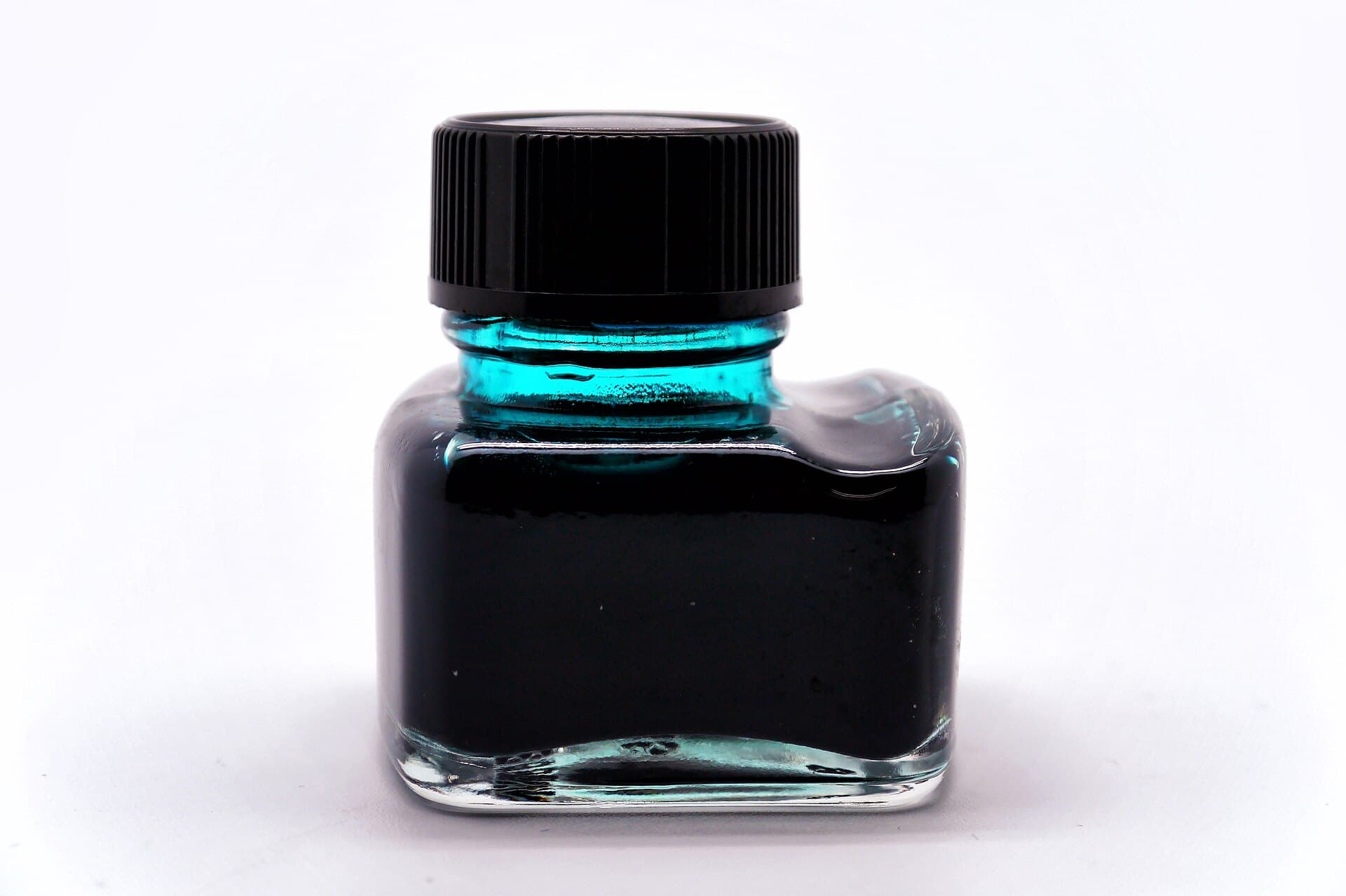
Image: Poulpy. CC BY-SA 3.0. See the image credits.

Ink is a grocery. It has a shelf life, a storage temperature, and a way of announcing that you have treated it badly. At the shop we packed bottles as if they were small bottles of wine that stained permanently. The customers who never had trouble were not lucky. They had a cupboard.
Australian storage is a specific problem. We have rooms that pass forty degrees with the blinds drawn, windowsills that could bake bread, and a culture of leaving interesting objects where the light can admire them. Ink does not want to be admired by the light. It wants to be capped.
The cupboard is the correct altar
Keep bottles upright, tightly capped, in the dark, away from the stove and the window. A wardrobe shelf is better than a desk. A desk is better than a car. A car is a way to make vinegar. If you have a collection, you do not need to display all of it. Display the empty box if you must display something.
Shake only what the maker says to shake. Shimmer inks want a roll, not a cocktail. Pigment inks want a gentle remix. Ordinary dye inks, including Iroshizuku, want to be left alone. If a dye ink has separated into something alarming, it may have evaporated or been contaminated. Do not rescue it with a pen you like.
Label the date you opened a bottle if you are the sort of person who opens many. You will not remember, and the last centimetre of a five-year-old sample vial is how feeds become archaeology.
Heat, evaporation, and the science project
A loose cap in a dry room lets water leave and dye stay. The ink gets thicker, wetter on the page in a way that is not generous, and harder to flush. A loose cap in a humid room lets the world in. Either way you have changed the product.
If ink grows a film, a smell, or filaments, throw it out. This is not thrift. This is how you protect a piston filler you spent money on. Do not boil it. Do not filter it through a coffee paper and call it vintage. There are always other blues.
In coastal houses, keep bottles out of the salt breeze. In tropical houses, consider that a shed is not a cellar. The humid-climate pen care essay is the companion to this one; the pen and the bottle are in the same weather.
Travelling with bottles, vials, and filled pens
A full glass bottle in a suitcase needs a bag, a wrap, and the humility to put it in the middle of the clothes, not against the wheel. We used to ship Iroshizuku as a gift and we packed it better than most people pack a holiday. Learn from the packing slip. If you only need a week of colour, decant into a small, purpose-made vial with a seal that you have tested in the sink. Do not decant into an old sample vial of unknown plastic.
Filled pens are easier than bottles and more likely to burp. Fill them quite full or empty them. Keep them capped and nib-up if you can. Do not clip a wet broad into a white linen pocket and then board a plane. If you are keeping a travel journal, one pen and one known ink is more useful than a rainbow that leaks.
Airport liquid rules apply to ink because ink is a liquid. Plan as if you were carrying shampoo that costs fifty dollars and stains. If that sounds annoying, it is. It is still better than a suitcase that has become a monochrome.
The last centimetre
Use it. That is what the Iroshizuku cone is for, and what a careful tilt is for on every other bottle. When you cannot decently fill a converter, use the last of it in a cheap pen you do not mind cleaning, or accept that the remainder is a stain on glass and a memory. Do not add water "to stretch it" unless you are deliberately making a wash and you understand you have created a new, less stable ink.
A bottle that has served you should be rinsed and recycled or kept as a vase for a single dry stem, not left half-alive on a sill. Storage is a form of respect for a product that is, in the end, coloured water with a reputation. Treat it like groceries. Write with it like a landscape.
Sample vials, decants and the honesty of plastic
A vial is only as good as its cap. Test it in a glass of water before you trust it in a suitcase. Label the colour with tape, not with memory. Do not decant shimmer into a vial you cannot clean. Do not decant pigment and then forget it for a year.
If you share samples, share the date opened and the climate it lived in. An Australian summer sample is not the same liquid as a shop sample from a temperate storeroom.
Housekeeping once a season
Once a season, open the cupboard and look. Tighten caps. Retire anything that has grown a film. Wipe the shelf. This is not a hobby of anxiety. It is the same housekeeping you would give to spices. Ink is closer to a spice than to a jewel. Treat it that way and the jewel-like bottles will last long enough to be used.
Children, pets and the glass problem
A beautiful bottle is a poison-looking object to a child and a knockable object to a tail. Store high, or store in a closed box. If you write with children at the table, use a vial and a cheap pen. The landscape names will still be there when the table is quieter.
Broken glass plus ink is a morning. Have a cloth that may die. Have the sense not to put the bottle at the edge of a verandah table because the light was good.
Questions from the bench
- Can bottled ink go off?
- Yes. Evaporation concentrates it, heat cooks it, and contamination grows things you do not want in a feed. If it smells sour, looks stringy, or has a film, do not put it in a pen.
- What is the safest way to fly with ink?
- Empty or very full pens, bottles in a sealed bag in checked or well-protected carry-on if the airline allows liquids, and no half-empty converters. Treat ink as a liquid, because it is one.
Further reading
Inks · 7 November 2024
Shading, sheen and shimmer without the mess
Three ways ink can be more than a flat colour, and three ways a feed can become a regret. A practical guide for Australian paper and Australian patience.
Inks · 16 October 2024
Pairing ink and paper in Australian conditions
A colour is not a colour until it dries on the page you actually use, in the humidity you actually have. Here is a pairing method that does not require a laboratory.

Inks · 17 July 2014
Iroshizuku, Japanese landscapes on the page
The bottles we waited on in 2014 were named for weather and water. They still are. Here is how those colours behave on Australian paper, and why the cone in the base is not a gimmick.