Fountain pens · 3 July 2024 · 9 min read
Why TWSBI demonstrators changed the hobby
A clear piston you could actually afford made ink visible, capacity ordinary, and maintenance a conversation. It also taught a generation about cracks, grease and patience.
By The Bookbinders desk
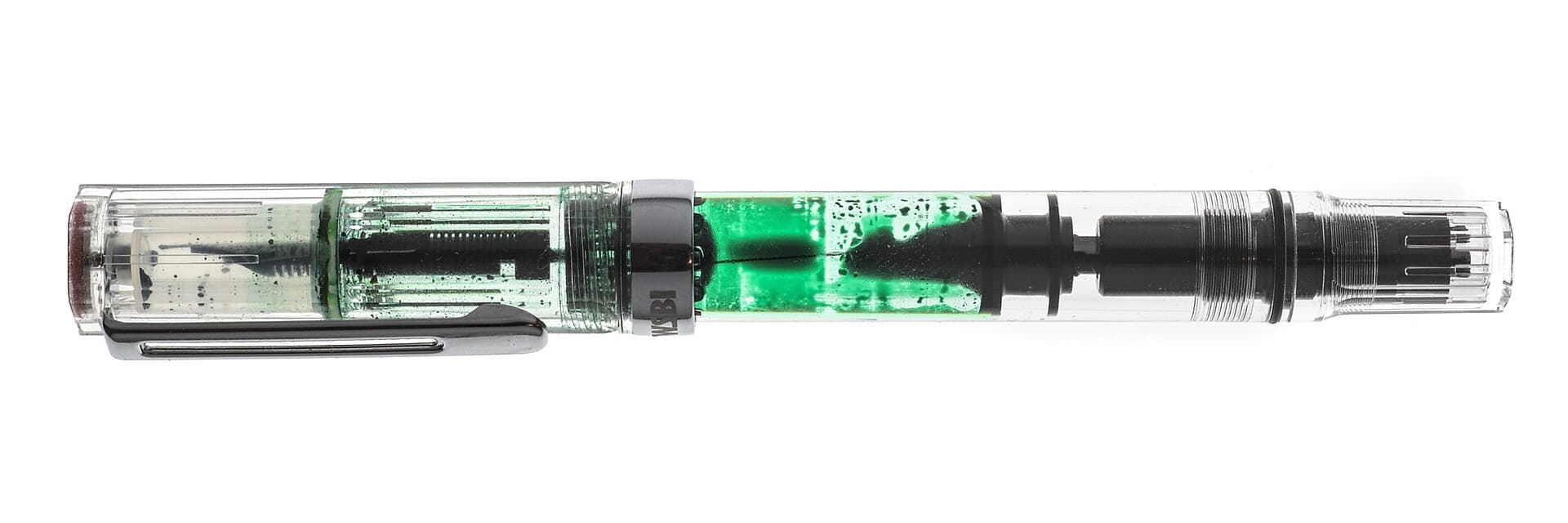
Image: Augustgeyler. CC BY-SA 4.0. See the image credits.

Before the Eco sat in our new arrivals row, a clear piston filler was a luxury object or a vintage risk. You could want to see the ink. You could not necessarily afford to. TWSBI — Taiwan, three letters that still get pronounced as a debate — put a demonstrator on the counter at a price that felt like stationery rather than jewellery. The old site listed them the way it listed Field Notes and sealing wax: as things a person might actually use.
That changed the hobby in Australia more than a limited Graf von Faber-Castell in the window ever did. People could watch a colour. They could see when they were about to run out. They could see, sometimes, a hairline crack they would rather not have seen. This is a grateful and unsentimental account.
What a demonstrator teaches
A clear barrel is an education. You learn how much ink a day of notes actually uses. You learn that a "full" pen still has a bubble. You learn that shimmer looks like a snow globe and then like a tide line. You learn that a feed is a piece of plastic with fins, not a mystery.
That visibility pulled ink out of the specialist corner and into ordinary conversation. Customers who had bought a Traveler's notebook for a trip to Japan would buy an Eco to put Iroshizuku in, because the pairing photographed itself. We did not mind. A pen that makes you look at ink is a pen that makes you buy better paper, and better paper is how the rest of the shop lives.
The Eco-T, the Diamond, the stub nibs that made handwriting look suddenly intentional — these were not the most expensive objects we sold. They were among the most talked about. A first-time buyer could understand a piston by watching it. That is worth more than a gold band.
The crack is not a rumour, and it is not the whole story
TWSBI plastic has split in the wild. Caps, barrels, the occasional surprise after a drop or an enthusiastic twist. Forums treat this as a morality play. Shops treat it as a warranty conversation and a chance to talk about force. Australian heat does not help. A clear barrel left in a car is a science experiment. So is a cap tightened as if it were a jar of pickles.
If you own one, do not over-tighten. Do not post the cap if the model is happier unposted. Do not leave it inked in a hot bag for a fortnight. Use the grease the maker intended on the piston, not a kitchen substitute. When something splits, stop using it as a water pistol and talk to the place you bought it. A cracked pen is disappointing. It is not a reason to decide all affordable pistons are a swindle.
We still recommended them, with the same sentence we used for leather covers: this is a tool with a known failure mode, and the known failure mode is not the same as junk.
How to live with a piston you can see
Flush more than you think, because you can see when you should. Do not let shimmer become a permanent weather system in the barrel. If you want a dedicated shimmer pen, make it a cheap converter pen and keep the Eco for honest dye. Unscrew the barrel over a sink. Keep spare O-rings if you are the sort of person who keeps spare O-rings. If you are not, keep the maker's care sheet.
Nib swaps on the Eco family are part of the appeal. A fine for forms, a stub for envelopes. That modularity is why the pen belongs in a first-pen conversation even when we told some beginners to start simpler. The nib guide will stop you buying a 1.1 millimetre for a hospital chart.
What changed after the demonstrator became ordinary
Once people could see ink, they became fussier about colour, and fussier about paper, and less willing to accept a dead cartridge in a desk drawer as the end of the story. Australian specialist shops — ours included — sold more bottles and more pads. The hobby got younger in the photos and older in the maintenance questions. Both were improvements.
TWSBI did not invent the piston or the demonstrator. It made them ordinary. Ordinary is how a shop on Gympie Road stays in the conversation. If you buy one, buy it as a tool you can see into, not as a mascot. Fill it. Watch it. Keep it out of the car. And when the ink is the colour of a Japanese pond, take a moment. That was the point.
Parts, grease and the video you should not follow
The maker publishes exploded diagrams for a reason. Follow those. A video shot in another country may use a grease you cannot buy or a force your barrel does not want. Australian heat makes some plastics less forgiving. If a part resists, stop. If a part cracks, stop using the pen as a toy and start the warranty conversation.
Keep a small bag for the spring you will drop once. That bag is not pessimism. It is how a demonstrator stays a tool.
After the Eco, what people bought next
Usually paper, then ink, then a second nib. Sometimes a more expensive demonstrator. Sometimes they went back to a cartridge pen and kept the Eco for Sundays. All of those paths are successes. The change TWSBI made was to put the inside of the hobby on the outside of the pen. Once you have seen it, you cannot quite unsee a feed. That is an education worth a known crack risk, if you accept the terms.
Teaching a beginner on a clear piston
If you put an Eco in a beginner's hand, fill it with them, over a sink, and make them flush it once before they leave. The visibility that makes the pen charming also makes the mess visible. That is a gift if you use it as teaching. It is a stain if you send them home with a full barrel and a smile.
We liked teaching on clear pens. We liked it less when the lesson was a cracked cap in a hot car. Give both lessons on the same day.
Questions from the bench
- Do TWSBI pens still crack?
- Some barrels and caps have, especially when over-tightened or left inked in heat. Many write for years. Treat the plastic with less force than it seems to invite, and do not treat a crack as a surprise if you ignored the care sheet.
- Is the Eco a good first fountain pen?
- It can be, if you want a piston and a clear barrel and you are willing to learn filling. If you want something simpler, start with a cartridge-converter Pilot or Platinum and come to the Eco second.
Further reading

Fountain pens · 11 August 2024
Pilot in Australia, from Metropolitan to Custom 823
Pilot is the brand we could put in a beginner’s hand and in a collector’s, without changing the sentence about feedback, cartridges and service. Here is the family as it actually arrives here.
Fountain pens · 18 June 2024
Looking after a fountain pen in a humid Australian climate
Heat, salt air and a January glovebox will teach you more about feeds than any forum. This is the maintenance we used to write on the back of an Aspley receipt.
Fountain pens · 9 May 2024
Filling systems without the mystique
Cartridge, converter, piston, vacuum and eyedropper are just ways of getting ink from a bottle into a feed. Here is how they behave in Australian heat, and which ones we trusted on the counter.